
Reviewed · BALINESE COOKING CLASSES
Balinese Cooking class with traditional morning market visit
Ubud’s best food lesson starts before the cooking: at a local morning market, where you can see, smell, and taste the ingredients that shape Balinese meals. Afterward, you head to Laplapan village to make a canang offering and cook several dishes with local chefs including Wayan and Dewa.
I like the small groups of up to eight, which leave room for questions and hands-on work. I also like the useful mix of food and culture: you learn why certain ingredients matter, then see how Balinese offerings are made before sitting down to eat your own cooking.
The one thing to consider is the six-hour length. The market visit is relatively brief, and the morning can feel full if you prefer a slow, leisurely class. Still, hotel pickup, air-conditioned transport, equipment, ingredients, and the meal are included for $35.
In This Review
- Key points at a glance
- Why this Ubud cooking class works so well
- The morning market: see Bali through its ingredients
- Laplapan village and the canang offering
- Cooking several Balinese dishes by hand
- The finished meal is part of the lesson
- What $35 includes, and where the value lies
- Timing, transport, and practical planning
- Who should book this class
- Should you book the Balinese cooking class?
- FAQ
- How long does the Balinese cooking class last?
- Is hotel pickup included?
- How many people can join the class?
- What food will I cook?
- Are vegetarian options available?
- What happens if I need to cancel?
Key points at a glance
- Morning market first: Choose from local vegetables, herbs, meat, fruit, and spices with help from your guide.
- Canang offering lesson: Make a traditional Balinese votive basket before cooking begins.
- Hands-on meal preparation: Prepare starters, main dishes, and dessert with guidance from a local chef.
- Small class size: The advertised maximum is eight people, making it easier to get personal help.
- Laplapan village setting: Cook in a clean, attractive workshop surrounded by the rural scenery of Ubud.
- Strong value: At $35 per person, the package covers transport, class fees, equipment, taxes, and the meal.
Why this Ubud cooking class works so well
A cooking class can be a pleasant way to spend a morning, or it can help you understand a place. This one aims for the second option. You do not simply arrive at a kitchen, follow a recipe, and leave. You begin by looking at the raw materials in a local market, then learn about a Balinese offering, then use local methods to prepare a full meal.
That order matters. It gives you a clearer picture of how food fits into daily life in Bali. At the market, you see the herbs, spices, vegetables, fruit, and meat before they are chopped and cooked. At the village workshop, you connect those ingredients with family cooking, ceremony, and hospitality.
The experience is especially useful if you have eaten Balinese food but cannot identify the flavors. Wayan and Dewa are named as members of the teaching team, while other sessions have been led by Putu or Puthu. The hosts explain the ingredients, show the techniques, answer questions, and keep the mood relaxed.
You should not expect a formal culinary school. This is a friendly, practical class where the emphasis is on participation, local food, and enjoying the finished meal. That makes it a good fit for beginners, families, solo visitors, and anyone who wants more than a restaurant meal.
More Balinese cooking classes:
- Ubud Cooking Class Bali with Balinese Chef
★ 5.0 · 1,609 reviews - Ubud: Cooking Class with Transfers and Optional Market Visit
★ 4.9 · 824 reviews - PRIVATE Authentic Balinese Cooking Class in Ubud at Putu’s Home
★ 5.0 · 644 reviews
The morning market: see Bali through its ingredients
Hotel pickup gets the day moving without the usual Ubud transport fuss. The vehicle is air-conditioned, which matters in Bali’s heat and humidity, especially if your hotel is outside central Ubud. The package includes transport from your hotel to the market and then onward to the workshop.
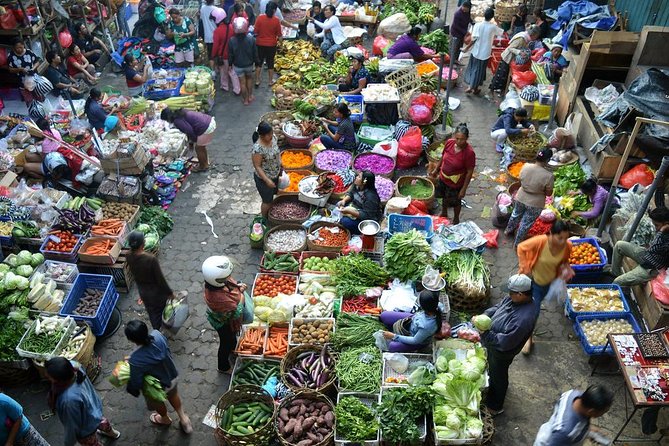
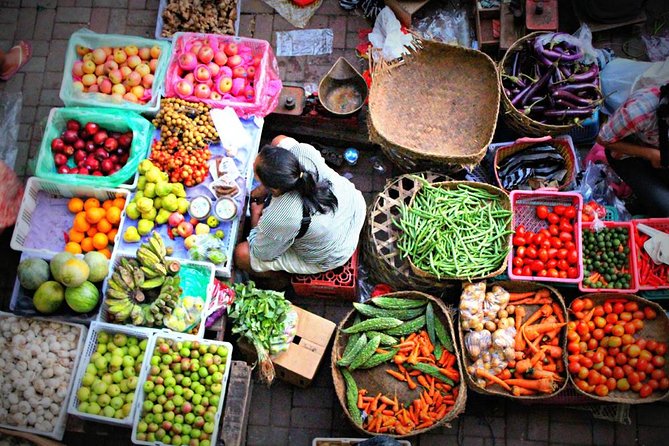
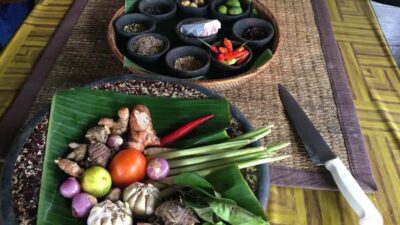
At the market, your guide helps you identify the ingredients used in Balinese cooking. You can expect to see vegetables, herbs, spices, meat, fruit, and other fresh foods on display. The point is not just shopping for the class. It is learning what local cooks buy and how unfamiliar ingredients are used.
This is also the most everyday part of the experience. A market visit gives you a quick look at ordinary food shopping rather than a polished cultural display. You might taste unfamiliar fruit or small local sweets, depending on what is available and how the class is arranged.
Keep your expectations in check here. One account describes the market portion as brief, so do not book this mainly as a long market walk. Think of it as an introduction to Balinese ingredients and a useful preface to the cooking session.
I would pay close attention to the herbs and spice mixtures. These are often the hardest parts to recreate at home because the names and appearances may be new to you. Ask questions while you are still at the market, when you can see the whole ingredients rather than just a prepared paste.
Laplapan village and the canang offering
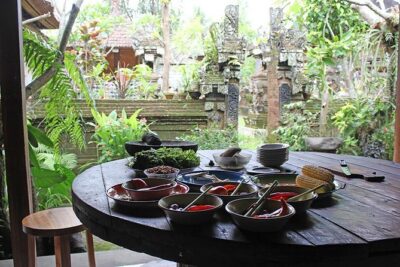
After the market, you continue to the traditional village of Laplapan. This change of setting helps the class feel connected to local life. Instead of spending the entire morning in a commercial kitchen, you reach a village workshop in the Ubud area, with a more peaceful, rural setting.
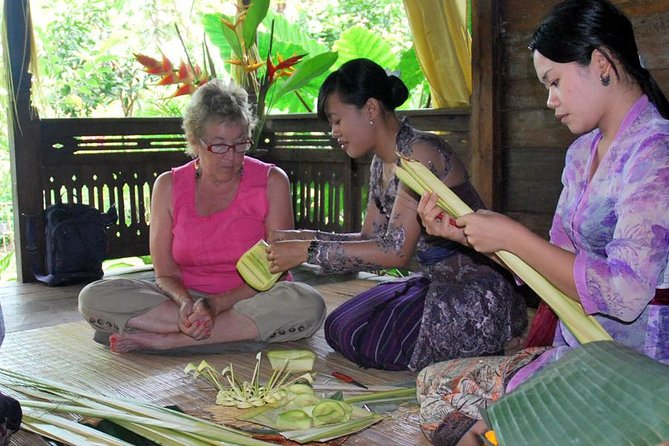
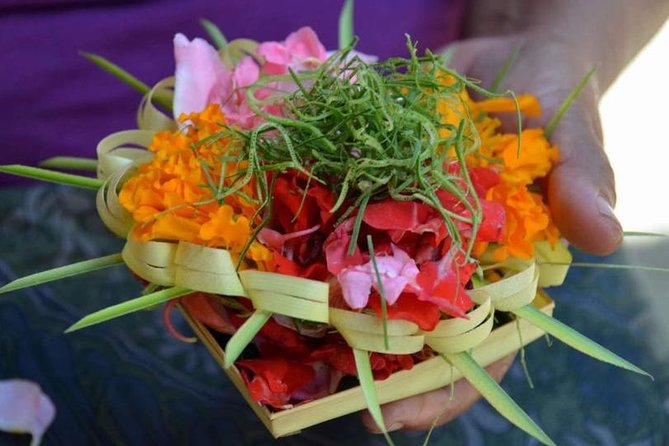
Before the cooking starts, the class includes a lesson on making canang and other offering items. A canang is a small Balinese votive offering, traditionally made from woven palm leaves and filled with flowers and other materials. Here, you get to make one yourself rather than only seeing finished offerings outside temples or homes.
This is a valuable part of the day because it adds cultural context without turning the class into a lecture. You learn through your hands. The task also slows things down before the busier cooking work begins.
The finished basket may look simple, but the process requires care. If you have never worked with palm-leaf material, give yourself time and follow the host’s directions closely. The class is designed to help you make the offering, not to test your craft skills.
Families can make good use of this portion. Children have a clear task, and the offering lesson gives them a way to take part in Balinese culture without needing a long attention span. The teaching team has also been praised for working well with children as young as six.
Cooking several Balinese dishes by hand
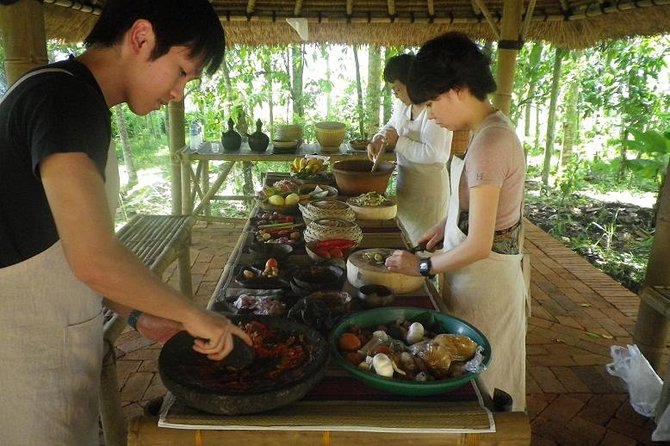
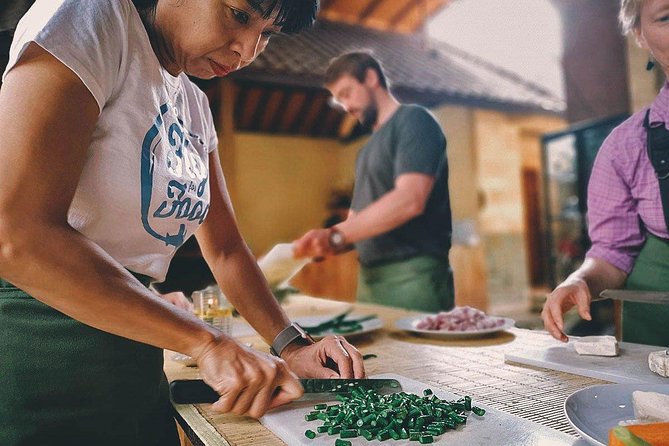
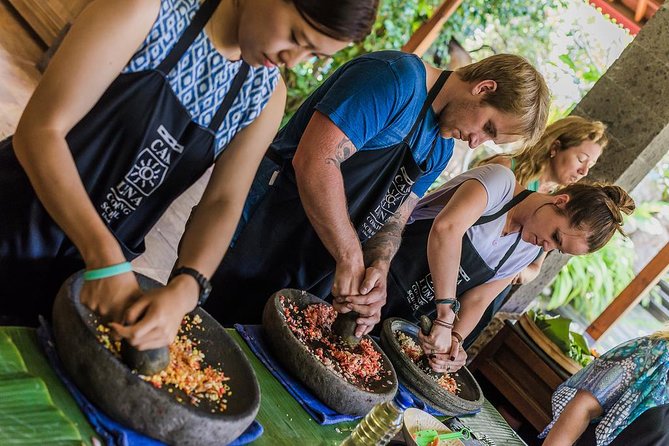
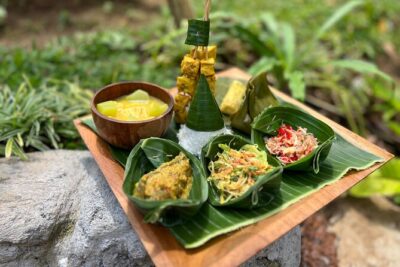
The central part of the class is practical. You prepare starters, main dishes, and an authentic dessert, with the chef showing you how to handle the ingredients and use traditional techniques. Depending on the session and menu, you may cook a substantial group of dishes. One class included nine dishes, while another was described as a five-course meal.
That variation is worth noting. Do not assume every date has exactly the same menu. The common thread is a multi-dish meal rather than one recipe, so you get a broad taste of Balinese cooking and several methods to take home.
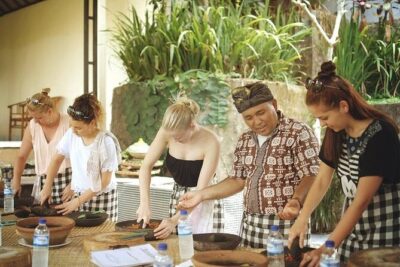
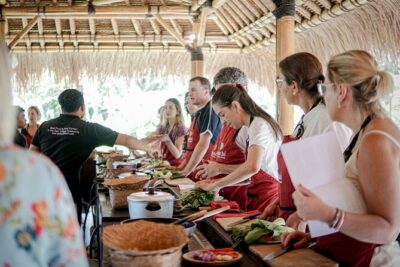
The class is built for participation. You chop, mix, season, and cook instead of standing behind a demonstration table. Some preparation may be done in advance so the group can finish within the six-hour schedule, but the class still gives you plenty of hands-on work.
This balance is sensible. If every ingredient were prepared from scratch in front of you, the morning could drag on. If everything were pre-cooked, you would learn very little. Here, the goal is to keep the pace moving while giving you useful jobs.
The teacher’s role is one of the strongest parts of the experience. Wayan is repeatedly described as patient, funny, welcoming, and easy to follow. Dewa and other staff members also help keep the class friendly and organized. If you are new to cooking, you can ask for help without feeling hurried.
If you already cook often, you can still get value from the class. Focus on the spice combinations, the order in which ingredients are added, and the local methods rather than just copying the recipe list. Those details are what make a home version taste more like the food you ate in Bali.
More market visits in Ubud:
- Balinese Ubud cooking school (9 Dish Cooking and Market Tour)
★ 5.0 · 540 reviews - Ubud: Balinese Cooking Class and Market Tour
★ 4.8 · 531 reviews - PRIVATE Ubud Market Tour & Balinese Cooking Class with Putu
★ 5.0 · 125 reviews - Ubud Traditional Night Market Food Tour-All Inclusive
★ 4.4 · 95 reviews
The finished meal is part of the lesson
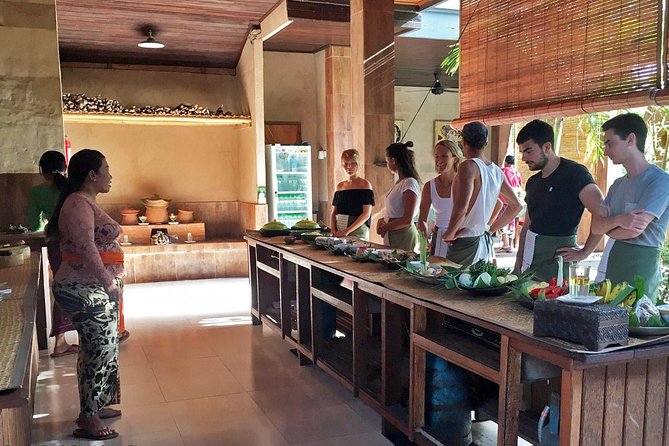
When the cooking ends, you sit down and eat what the group has made. This is not a quick sample at the kitchen counter. The meal is presented as the payoff for the morning’s work, and several accounts describe generous portions and attractive presentation.
The shared meal also gives you time to talk with the other people in the class. Solo visitors can meet fellow cooks, while families and couples get a relaxed meal that they have prepared together. The setting is described as clean and pleasant, with some sessions taking place in a beautiful local home.
Do not expect restaurant-level control over every detail. You are cooking as a group, so the final result depends partly on how everyone works together. That is part of the charm, but it means this is not the right choice if you want a private chef preparing every course for you.
Dietary needs can be accommodated in some cases. Vegetarian options have been provided, and the cooking team has adapted to dietary requirements. You should raise any restrictions when booking or before the class starts, since the available menu and substitutions are not specified in detail.
A recipe book or recipe information may be provided, depending on the session. One experience included a recipe book to help recreate the dishes at home. It is still wise to take notes, since the most useful lessons may be the visual cues and small technique tips that are difficult to capture in a printed recipe.
What $35 includes, and where the value lies
At $35 per person, this is a strong-value half-day activity in Ubud. The price includes hotel pickup, air-conditioned transport, cooking equipment, cooking class fees, taxes, ingredients for the session, and the meal you prepare.
You are paying for more than food. The package combines transport, a market visit, a cultural activity, cooking instruction, and lunch. Booking each part separately would be awkward, and the included vehicle is useful if you are staying away from central Ubud.
The small class limit improves the value. With a maximum of eight people, the chef can give individual help, and you have a better chance of handling the food yourself. In a larger class, you might only watch while one person at each station does the work.
Personal expenses are not included, so bring money if you want anything extra at the market or elsewhere. The provided details do not specify additional purchases, but this is a simple point to keep in mind when planning your morning.
The experience has a 5 out of 5 rating based on 161 ratings, with 99 percent recommending it. Those figures suggest a very consistent level of satisfaction, especially for an activity that depends on transport, food, and several different staff members working together.
Timing, transport, and practical planning
The total duration is about six hours. Pickup is offered from your hotel, but the exact pickup time and coverage should be confirmed when you book. A report of pickup from as far away as Sanur shows that the service can cover more than central Ubud, though you should not assume every distant hotel is included.
The air-conditioned vehicle is a practical benefit, not a luxury extra. Bali roads can be slow, and the combination of market, village, and workshop means you will be moving between locations. Having transport arranged saves you from hiring separate rides and trying to find the cooking school yourself.
Wear clothes that can handle a little food splatter and shoes suitable for a market and village setting. The activity is not described as physically difficult, but you will be standing, moving around the cooking area, and working with ingredients for much of the morning.
The class has mobile ticketing and confirmation is received at booking. Free cancellation is available up to 24 hours before the start time for a full refund. Changes or cancellations inside that window are not accepted, so check your Ubud plans before committing.
Who should book this class
I would recommend this experience to you if food is one of the main ways you like to understand a culture. The class gives you direct contact with ingredients, cooking methods, village life, and a Balinese offering, all within one morning and early afternoon.
It is also a smart choice for first-time cooking-class participants. The teachers provide guidance, the menu includes several dishes, and the tone is social rather than intimidating. You do not need advanced kitchen skills to take part.
Families should consider it, especially if children enjoy making things with their hands. The class has worked well for children ages six, eight, and nine, and the offering activity adds variety beyond cooking.
Solo visitors can also fit in easily. The small group gives you a chance to meet other people, and the shared meal provides a natural way to chat. Couples who want a food-focused cultural activity will find more substance here than in a standard restaurant outing.
I would think twice if you want a long, serious market tour, a private class, or a quiet morning with little structure. The six-hour schedule includes several stages, and the group format means you will share the cooking space and final meal.
Should you book the Balinese cooking class?
Yes, if you want a practical introduction to Balinese food and customs at a reasonable price. The best features are the local market stop, the canang-making lesson, the patient teaching style associated with Wayan and the other hosts, and the chance to cook enough dishes for a proper meal.
Book it early in your Bali stay if possible. The class can help you recognize ingredients and understand dishes on later restaurant visits. Just confirm pickup details and dietary needs in advance, and remember that the market stop is an introduction rather than a full morning market tour.
FAQ
How long does the Balinese cooking class last?
The experience lasts approximately six hours, including hotel pickup, the morning market visit, the visit to Laplapan village, the offering lesson, cooking, and the sit-down meal.
Is hotel pickup included?
Yes. Pickup is offered from your hotel, and air-conditioned transport to the market and cooking workshop is included. Confirm the exact pickup details when booking.
How many people can join the class?
The advertised maximum is eight travelers, allowing for a small-group format and more direct help from the cooking team.
What food will I cook?
You will prepare several Balinese dishes, including starters, main courses, and an authentic dessert. The exact menu can vary, and some sessions have included as many as nine dishes.
Are vegetarian options available?
Vegetarian options have been provided, and the cooking team has adapted to dietary requirements. Tell the provider about your needs before the class so the menu can be planned appropriately.
What happens if I need to cancel?
You can cancel up to 24 hours before the experience begins for a full refund. Cancellations or changes made less than 24 hours before the start time are not accepted for a refund.
More Workshops in Ubud
- Hands-On Silver Jewelry Making Near Ubud’s Monkey Forest
★ 4.9 · 1,789 reviews - Ubud Silver Class Jewelry making in bali
★ 5.0 · 978 reviews - Canggu: Bali Turtle Silver & Gold Workshop
★ 4.9 · 643 reviews - Balinese Farm Cooking Class by Pemulan Bali
★ 5.0 · 410 reviews
More Shopping Tours in Ubud
- Ubud Cooking Class with Optional Market Visit Pickup Included
★ 5.0 · 70 reviews - Balinese Cooking Class with Traditional Market Tour
★ 5.0 · 66 reviews - Ubud : Regular or Vegetarian cooking class with market visit
★ 4.8 · 57 reviews - Bali Food Tour: Savor Street Food and Night Market Adventures
★ 5.0 · 46 reviews
Just added around Ubud
- Authentic hike in the forest with lunch at the inhabitant★ 5.0 · 3 reviews
- Heaven Gate, Tirtagangga and Tukad Cepung Waterfall – All Inclusive★ 5.0 · 3 reviews
- Half Day Uluwatu Temple Sunset, Kecak Dance and Seafood Dinner★ 3.5 · 3 reviews
- Ubud: White Water Rafting with visit Ubud Monkey Forest★ 5.0 · 3 reviews
- ️Bali All Inclusive Tour: Ubud – Tegalalang – Kintamani★ 5.0 · 3 reviews
- East Bali and Lempuyang Temple Tour★ 5.0 · 3 reviews
- Ubud: Temple, Swing, Waterfall, Rice Terrace & Monkey Forest★ 5.0 · 3 reviews
- Blue Lagoon Snorkeling and Lunch with Tukad Cepung Waterfall★ 5.0 · 3 reviews
Balinese Cooking Classes, compared.
Cooking Class with Transfers and Optional Market Visit
Read our review →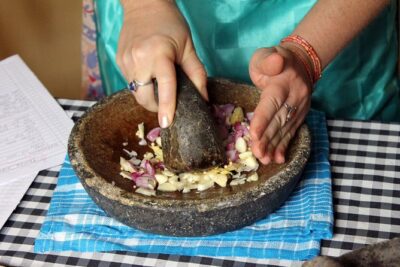
PRIVATE Authentic Balinese Cooking Class in Ubud at Putu’s Home
Read our review →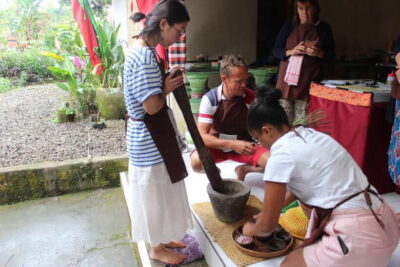
PRIVATE Balinese Cooking Class in Ubud with Dewa with Transfers
Read our review →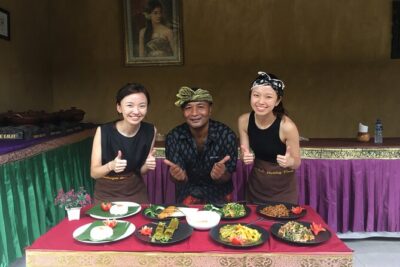
Browse the lists this tour appears in