
Reviewed · BALINESE COOKING CLASSES
Private Balinese Cooking Class in Ubud at Santika’s Home
Balinese cooking makes more sense when you see the ingredients before they reach the plate. This private class with chef Santika takes you from a local market, if you choose that option, to his open home kitchen in Pesalakan village, surrounded by rice paddies. I like the market-to-meal connection and the chance to work directly with local spices rather than simply watch a demonstration.
I also like that the class is genuinely private, with your own chopping board, stove, and mortar and pestle. The main consideration is the price: at $68 per person, it is not the cheapest cooking lesson in Bali, and transport outside central Ubud costs extra.
In This Review
- Key points at a glance
- From central Ubud to Santika’s village kitchen
- The market option: cassava, ferns, and Balinese spices
- Inside the open kitchen with chef Santika
- Why the spice work matters
- Sitting down to eat what you prepared
- Vegetarian, vegan, and allergy planning
- Is $68 per person a fair price?
- Who will enjoy this class most?
- Practical details before you book
- Should you book Santika’s cooking class?
- FAQ
- How long does the Balinese cooking class last?
- Where does the cooking class take place?
- Is hotel pickup included?
- Does the experience include a market visit?
- Can I request a vegetarian or vegan meal?
- Is the cooking class private?
- What is the cancellation policy?
Key points at a glance
- Chef Santika’s home kitchen: Learn from a professional chef in the home he shares with his wife.
- Optional local market visit: See cassava, ferns, lemongrass, bananas, and seasonal produce before cooking.
- Hands-on for about 1.5 hours: You chop, pound, mix, and cook rather than sit back and watch.
- Private experience: Only your own group takes part, even though the property also operates as a homestay.
- Rice-field setting: Pesalakan village is about 20 minutes from central Ubud.
- Flexible meal options: Vegetarian, vegan, lactose-free, and gluten-free meals can be arranged in advance.
From central Ubud to Santika’s village kitchen
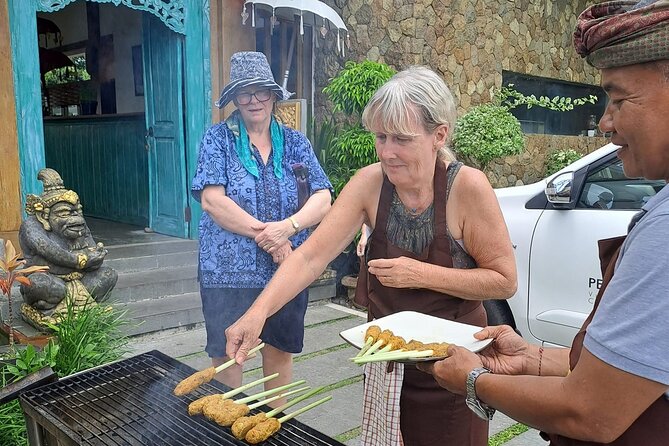
The experience begins with pickup from a central Ubud hotel. Santika’s home is in Pesalakan village, about a 20-minute drive from Ubud’s city center, and the change in setting is part of the appeal. You leave the town’s cafés and traffic behind for a home property surrounded by rice paddies.
Pickup and drop-off are included when your hotel is within the stated 10-kilometer radius of Santika’s home. If you stay beyond that area, transportation costs extra, so check your hotel’s location before booking. Include the hotel name on your reservation so the pickup can be arranged properly.
This transfer matters because the class is not in a central cooking school designed for large groups. You are going to a working home and homestay, where the setting feels more personal and connected to daily life in Bali. The tradeoff is that the trip requires transport and takes part of the three-hour experience.
The property may have other homestay occupants, but your cooking activity remains private. That gives you room to ask questions, set your own pace, and focus on the food without sharing a workbench with strangers.
More Balinese cooking classes:
- Ubud Cooking Class Bali with Balinese Chef
★ 5.0 · 1,609 reviews - Ubud: Cooking Class with Transfers and Optional Market Visit
★ 4.9 · 824 reviews - PRIVATE Authentic Balinese Cooking Class in Ubud at Putu’s Home
★ 5.0 · 644 reviews
The market option: cassava, ferns, and Balinese spices
If you select the market and cooking option, your first stop is a local market. This is not just a quick shopping errand. Santika uses the visit to introduce you to ingredients that may be unfamiliar if your usual Balinese meal begins at a restaurant table.
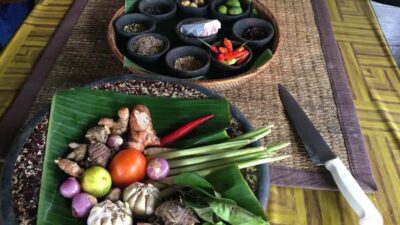
You might see cassava, young ferns, lemongrass, and several kinds of bananas, along with spices and vegetables that change with the season. The menu is not fixed year-round, so the market helps explain why the meal may vary from one visit to another.
You may also buy spices or seasonal vegetables that later appear in your meal. That small detail gives the cooking class a clear thread. You see the produce, learn what it is, carry it to the kitchen, and then use it yourself.
I consider the market option worth serious thought if you want more than a standard cooking lesson. It adds context to the food and helps you recognize the ingredients you may see again during the rest of your Bali trip. It also gives you a better sense of how much local cooking depends on what is available that day.
The drawback is time. The class itself includes about 1.5 hours of hands-on cooking, and the full activity lasts around three hours. If your main goal is simply to prepare and eat a meal, the cooking-only option may be the more efficient choice.
Inside the open kitchen with chef Santika
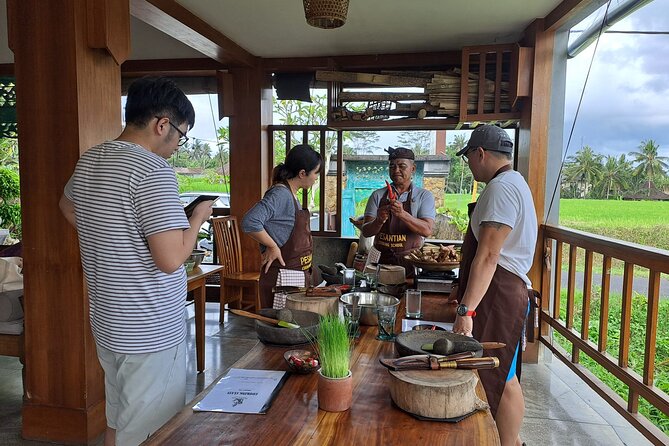
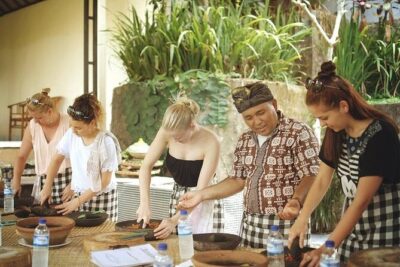
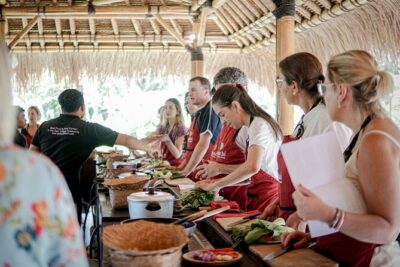
At Santika’s home, you join him and his wife in an open kitchen. Santika is a professional chef, but the format is friendly and practical rather than formal. You are there to cook alongside him, not watch him do all the work.
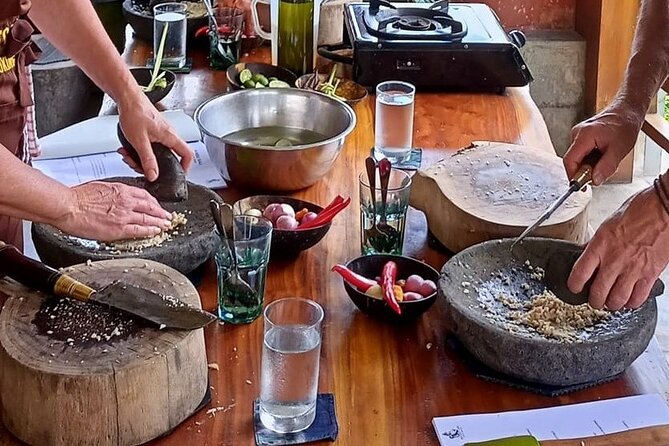
Each participant has a personal work area with a chopping board, stove, and mortar and pestle. That setup makes a real difference. You can practice the motions yourself, especially the traditional pounding and blending of spices that gives Balinese food much of its character.
Expect to handle local ingredients and spices while preparing a selection of traditional daily dishes. The exact menu depends on the season, and that is a strength rather than a flaw if you want food that reflects what is available in Bali at the time of your visit.
Do not expect a restaurant-style kitchen or a polished stage show. This is a home setting, and the experience is built around participation. You may find the pace less predictable than a large commercial class, but that is also what allows the session to feel personal.
The class lasts about 1.5 hours. That is enough time to take part in the preparation without turning the day into a long culinary course. Families should find the work approachable, and the format has already proved suitable for children who enjoy hands-on tasks.
Why the spice work matters
Balinese food is not simply about adding heat. The process of preparing the spice mixture helps you understand how flavor is built, and the mortar and pestle put that process directly in your hands.
You will learn how local ingredients are combined and used in everyday dishes, though the supplied details do not promise a particular recipe list. That is worth keeping in mind if you are hoping to prepare one exact dish. The menu may change with the season and with the dietary needs of your group.
The class is especially useful if you have eaten Indonesian food before but want to understand Balinese cooking on its own terms. The local focus gives you more than a broad introduction to Indonesian cuisine. It connects the food to the ingredients, the village setting, and the methods used in a Balinese home kitchen.
I also like the way this format serves both beginners and people who already cook. Beginners get a clear introduction to unfamiliar vegetables and spices. More experienced home cooks can pay closer attention to technique, texture, and the way ingredients are prepared by hand.
A few more Ubud half-days to weigh up
- Hands-On Silver Jewelry Making Near Ubud’s Monkey Forest
★ 4.9 · 1,789 reviews - Ubud Silver Class Jewelry making in bali
★ 5.0 · 978 reviews - Canggu: Bali Turtle Silver & Gold Workshop
★ 4.9 · 643 reviews - Ubud: Balinese Cooking Class and Market Tour
★ 4.8 · 531 reviews
Sitting down to eat what you prepared
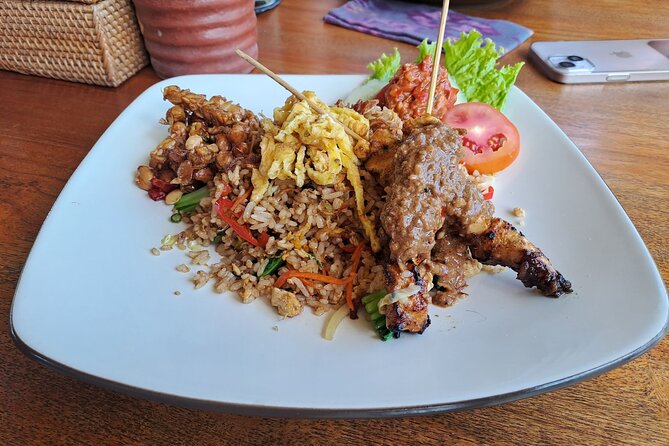
After the cooking session, you sit down to enjoy the meal you helped make. This is more satisfying than being handed a plate at the start because you have seen the ingredients and taken part in the preparation.
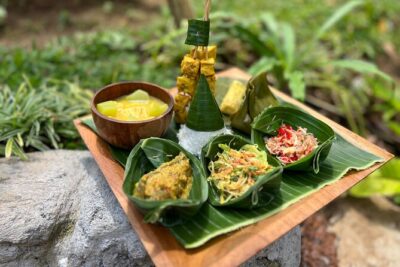
The meal is home-cooked Balinese food, with the menu shaped by the season. You should not book this expecting a fixed restaurant menu. Instead, think of it as a chance to eat the day’s cooking in the same home where it was prepared.
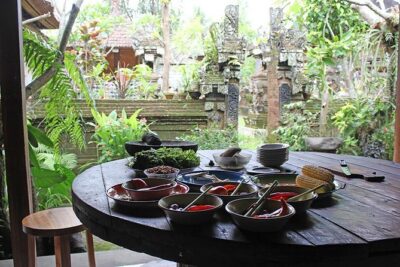
This final meal also gives you time to appreciate the setting. Santika’s home is in a village among rice paddies, away from central Ubud. The food and location work together, giving you a stronger sense of place than a class held in a city restaurant.
The available details do not specify how many dishes you will prepare or exactly how long the meal lasts. If you have strong preferences, tell the provider when booking and ask about the current menu. Dietary requests should be provided in advance, not at the kitchen door.
Vegetarian, vegan, and allergy planning
Vegetarian and vegan options are available. The class can also accommodate lactose-free and gluten-free diets, provided you make the request when booking.
That flexibility makes the experience suitable for mixed groups, including families or friends with different eating needs. Still, dietary restrictions are not a minor detail here. The class centers on shared ingredients and spice preparation, so early notice gives Santika a fair chance to plan the meal.
You should also report food allergies, cooking preferences, and any other restrictions at the time of reservation. The menu changes by season, which means the ingredients used may not be identical from one date to another.
Is $68 per person a fair price?
The listed price is $68 per person. That puts the experience above a basic group cooking class, but the comparison is not quite like for like.
Your fee covers a private class with a professional chef, a home-cooked Balinese meal, round-trip transport from eligible central Ubud hotels, and gratuities. If you select the market option, it also includes the local market visit. The private format is the biggest value point: your group does not share the lesson with a large public class.
For a solo visitor, the cost may feel high. A private transfer and private instruction are being built into the price, and one person does not spread those costs across a group. For a family or small group, the value improves because everyone can participate without paying for a separate private guide or arranging transport independently.
The price also makes more sense if you care about personal contact and cooking technique, not just lunch. If you only want to sample Balinese dishes, a restaurant will cost less. If you want to understand how the food is made and take part in the process, this offers more.
The experience is often booked well ahead, with an average advance booking period of 54 days. That does not guarantee that every date fills early, but it is a useful planning signal. If you want a particular day during a busy Ubud stay, book before your schedule is full.
Who will enjoy this class most?
I would recommend this experience to several types of visitors:
- Families with children: The class gives children practical tasks, and the private setting lets your group work at its own pace.
- Home cooks: The mortar and pestle work, local ingredients, and seasonal menu offer useful ideas to take home.
- Food-focused visitors: The market option links the raw ingredients with the finished meal.
- Vegetarian and vegan diners: Dietary options are available if requested in advance.
- Visitors seeking local contact: You spend time in a Balinese home rather than only in commercial restaurants.
- Small private groups: The cost becomes easier to justify when several people share the experience.
I would be less enthusiastic if your schedule is very tight or if you want a fixed menu with a guaranteed list of dishes. The activity takes about three hours, requires a drive from central Ubud, and changes with the season.
Practical details before you book
Hotel pickup and drop-off apply to central Ubud hotels within 10 kilometers of Santika’s home. Staying farther away does not prevent you from joining, but you should expect an extra transportation charge.
The activity is offered as a mobile ticket, and confirmation is received at booking. It is a private tour, so only your group participates in the class. Service animals are allowed, and the location is near public transportation, though the included pickup is the simpler option for eligible Ubud hotels.
Free cancellation is available if you cancel at least 24 hours before the local start time. Cancellations made less than 24 hours ahead are not refunded, and changes inside that window are not accepted.
Should you book Santika’s cooking class?
Book it if you want a personal introduction to Balinese food, especially one that connects a local market, a village home, hand-prepared spices, and a meal you cook yourself. The strongest parts are the private work area, Santika’s professional cooking background, and the chance to see ingredients such as cassava, ferns, lemongrass, and seasonal bananas before they reach the plate.
Choose the market option if food culture matters as much to you as the cooking. Choose cooking-only if you have limited time or mainly want the hands-on lesson.
At $68 per person, this is best viewed as a private cultural experience with transport and lunch included, not as a cheap meal. For families, couples, and small groups who value direct contact with local food traditions, it is a solid choice. For budget diners or visitors who need a tightly scheduled, fixed-menu activity, it may not be the best fit.
FAQ
How long does the Balinese cooking class last?
The full experience lasts approximately three hours. The hands-on cooking portion lasts about 1.5 hours.
Where does the cooking class take place?
The class takes place at chef Santika’s home in Pesalakan village, about a 20-minute drive from central Ubud. The home is surrounded by rice paddies.
Is hotel pickup included?
Round-trip pickup and drop-off are included for hotels in central Ubud that are within a 10-kilometer radius of Santika’s home. An additional transportation charge applies for hotels outside that area.
Does the experience include a market visit?
The market visit is included only if you choose the market and cooking tour option. During the visit, you may see cassava, ferns, lemongrass, bananas, spices, and seasonal vegetables.
Can I request a vegetarian or vegan meal?
Yes. Vegetarian, vegan, lactose-free, and gluten-free options are available. You should provide dietary restrictions, allergies, and cooking preferences when booking.
Is the cooking class private?
Yes. Only your own group takes part in the activity. Other people may be staying at the homestay on the property, but the Traveling Spoon cooking experience remains private.
What is the cancellation policy?
You can cancel for a full refund up to 24 hours before the experience start time. Cancellations or changes made less than 24 hours before the start time are not accepted for a refund.
Just added around Ubud
- Authentic hike in the forest with lunch at the inhabitant★ 5.0 · 3 reviews
- Heaven Gate, Tirtagangga and Tukad Cepung Waterfall – All Inclusive★ 5.0 · 3 reviews
- Half Day Uluwatu Temple Sunset, Kecak Dance and Seafood Dinner★ 3.5 · 3 reviews
- Ubud: White Water Rafting with visit Ubud Monkey Forest★ 5.0 · 3 reviews
- ️Bali All Inclusive Tour: Ubud – Tegalalang – Kintamani★ 5.0 · 3 reviews
- East Bali and Lempuyang Temple Tour★ 5.0 · 3 reviews
- Ubud: Temple, Swing, Waterfall, Rice Terrace & Monkey Forest★ 5.0 · 3 reviews
- Blue Lagoon Snorkeling and Lunch with Tukad Cepung Waterfall★ 5.0 · 3 reviews
Balinese Cooking Classes, compared.
Cooking Class with Transfers and Optional Market Visit
Read our review →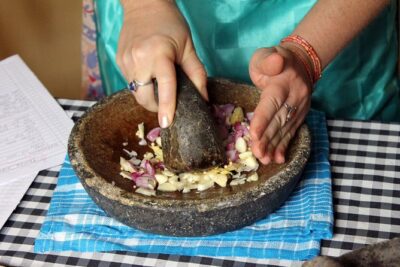
PRIVATE Authentic Balinese Cooking Class in Ubud at Putu’s Home
Read our review →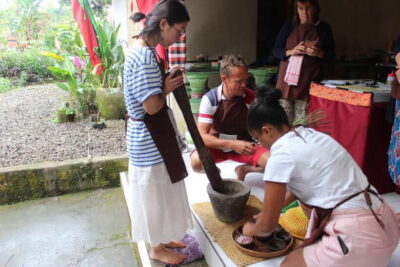
PRIVATE Balinese Cooking Class in Ubud with Dewa with Transfers
Read our review →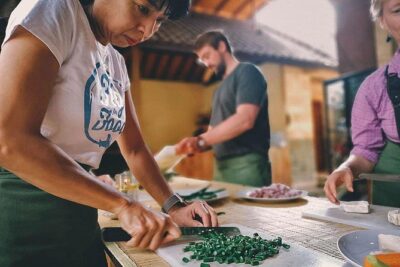
Balinese Cooking class with traditional morning market visit
Read our review →Browse the lists this tour appears in