
Reviewed · UBUD
The Essence Of Bali
The most interesting part of The Essence of Bali is its focus on how Balinese beliefs fit together. In one morning, you visit an ancestral site linked to animist traditions, a Hindu water temple, and a Buddhist stupa where the two faiths meet. You also see how village life, architecture, and irrigation connect to religion.
I like the small, private format and the chance to spend time in a Balinese family compound rather than simply moving from one famous temple to the next. I also like that the tour explains Tri Hita Karana, the Balinese idea of balance between people, nature, and the spiritual world.
The main consideration is pace. Five hours is enough for a thoughtful introduction, but not a full survey of Bali’s culture. The religious sites also require respectful dress and behavior, and the water purification portion is optional, not a casual swim.
In This Review
- Key points to know before booking
- Why this is a different Ubud cultural tour
- Starting in Manukaya with a Balinese family
- An eighth-century ancestral temple
- The holy springs at Tampaksiring
- A Buddhist stupa with Hindu connections
- Lunch with the hosts
- What the five-hour schedule feels like
- Is the $98 price good value?
- Who will enjoy this experience most?
- Small details that can improve the morning
- Should you book The Essence of Bali?
- FAQ
- Where does The Essence of Bali start?
- What time does the tour begin?
- How long does the experience last?
- Is this a private tour?
- Can I take part in the holy spring bathing?
- What is included in the price?
Key points to know before booking
- Three belief systems in one morning: Visit an ancestral temple, a Hindu water temple, and a Buddhist stupa.
- A family compound in Manukaya: Begin with a welcome drink and an introduction to Balinese script, masks, architecture, and daily life.
- A sacred water experience: At Tampaksiring, you may bathe in the holy springs, with a sarong and towel provided.
- Private transportation: Your own group travels by private vehicle, making the half-day outing more personal and easier to discuss.
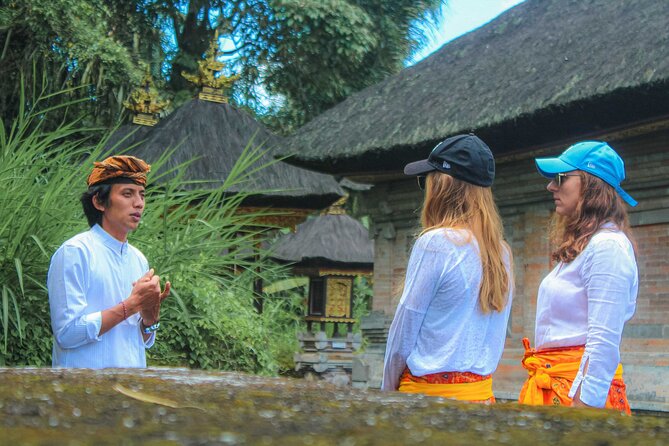
- Local guides with a personal connection: Guides including Gede, Eka, Nyoman, Ari, and driver Wayan have led this experience, with Gede described as a native of the village area.
- Lunch with your hosts: Coffee or tea and lunch are included, giving the tour a social finish rather than ending at the last monument.
Why this is a different Ubud cultural tour
Many Ubud excursions string together temples, rice terraces, and craft stops. This one takes a narrower path: it uses the Pakerisan River Valley to explain the foundations of Balinese spiritual life.
The valley lies northeast of Ubud and was listed as a UNESCO Cultural Heritage Area in 2012. Its importance comes from ancient sites dating from the eighth through twelfth centuries. That gives the morning a useful sense of place. You are not only looking at carvings and courtyards. You are seeing a part of Bali where old beliefs, imported religions, farming, and village organization developed side by side.
The tour also explains how animist beliefs joined with Hinduism and Buddhism after ideas and practices moved from India through Javanese kingdoms. That matters because Balinese religion is not easily sorted into one category. You may see Hindu rituals, Buddhist symbols, and older local traditions sharing the same cultural space.
I especially like the attention to subak, Bali’s traditional irrigation system. The subject is more useful than a quick photo stop because it shows how farming depends on cooperation, water management, and religious life. The related idea of Tri Hita Karana adds another layer: balance among the natural, physical, and spiritual worlds.
This is a good choice if you want context. It is less suited to you if your main goal is a long list of dramatic sights or a full day of sightseeing.
Other Ubud days people book alongside this one:
- All-Inclusive Ubud Private Tour
★ 5.0 · 14,344 reviews - Best of Ubud Full-Day Tour with Jungle Swing
★ 5.0 · 8,571 reviews - Ubud: Monkey Forest, Jungle Swing, Rice Terrace, and Water Temple
★ 5.0 · 7,160 reviews
Starting in Manukaya with a Balinese family
The tour begins at 9:00 am. The stated meeting point is Bali Pure Tour in Banjar Penempahan, on Jalan Melati in Desa Manukaya, Tampaksiring. Pickup is offered, but because the published start point is also specific, confirm the pickup arrangement when booking.
From the hotel, the drive follows backroads toward Penempahan village. That route is part of the appeal. You move away from the most direct tourist circuit and reach a village setting where the tour’s cultural focus makes more sense.
Your first stop is a Balinese family compound in Manukaya. You receive a welcome drink and see examples of lontar, the traditional Balinese script written on palm leaves, along with topeng, or masks. These are small details, but they help you understand that Balinese culture is expressed through writing, performance, ritual objects, and home design, not only through temple ceremonies.
A family compound is also a useful place to discuss architecture. Balinese homes and compounds are arranged according to social and spiritual ideas, and the tour connects those patterns to the wider outlook of Tri Hita Karana. The supplied details do not specify every building or room you will enter, so expect an introduction rather than a lengthy architectural study.
This opening stop takes only about a minute in the stated schedule, though the broader visit is part of the main cultural program. That timing suggests the compound is a brief welcome and orientation before the temple visits. If you enjoy conversation and questions, this is a good place to ask how the family compound works and how the objects on display are used.
An eighth-century ancestral temple
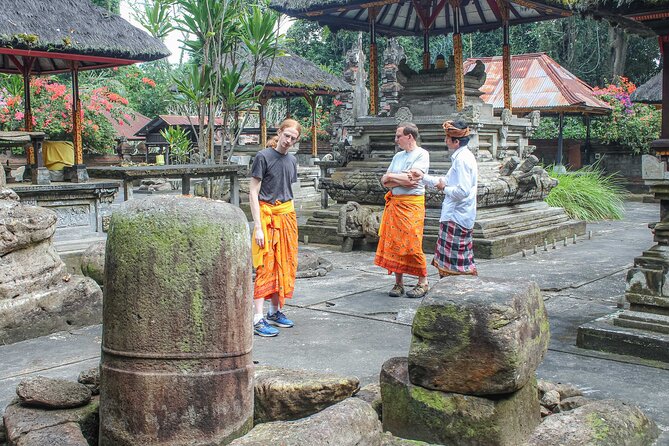
The first major temple visit is an ancestral temple dating to the eighth century. Its age is important, but the bigger point is what it represents: local belief systems that existed before Hindu and Buddhist influences became part of Bali’s religious life.
The setting in the Pakerisan Valley gives the visit historical weight without turning it into a museum lecture. Your guide can connect the site to ancient animist ideas, where natural forces, ancestors, and sacred places were part of community life.
Guides named Gede, Eka, and Nyoman have been associated with the experience, while Ari has also led groups with driver Wayan. The strongest reason to book this tour is the guide-led interpretation. At old temple sites, stone and carvings can be hard to read on your own. The value comes from hearing how the place fits into Balinese beliefs.
One practical point: temple visits call for respectful clothing and conduct. The supplied information does not set out a detailed dress code for every stop, so ask ahead if you need precise guidance. You should also expect a cultural visit rather than a site where you are free to wander without explanation.
The holy springs at Tampaksiring
The next stop is a sacred water temple at Tampaksiring, dating to the eleventh century. Devotees come here to cleanse themselves spiritually in the holy springs, and you may take part if you wish.
This optional participation is one of the tour’s most distinctive features. You are not required to bathe, so you can observe the ritual and listen to the explanation if that feels more appropriate. If you do join, a sarong and towel are provided, which makes the experience easier than arranging the basics yourself.
Keep your expectations clear. This is a religious act, not a spa visit or a standard attraction involving water. Follow your guide’s instructions, dress respectfully, and treat the ceremony as a sacred practice. The tour is strongest when you approach it with interest rather than treating it as a photo opportunity.
The water temple also gives you a direct example of Tri Hita Karana. Nature, the human body, community practice, and spiritual belief meet at the springs. That connection is more memorable than simply being told that Bali is spiritual.
The tour description does not state how long you spend at the water temple or whether changing facilities are available beyond the provided sarong and towel. If you plan to participate, ask about practical arrangements before the morning begins.
A completely different day out, same corner of Ubud:
- Ubud: Waterfalls, Water Temple & Rice Terraces Private Tour
★ 5.0 · 5,484 reviews - Ubud: All-Inclusive Tour with Optional Lunch
★ 4.9 · 5,438 reviews - Ubud: Guided ATV Quad Bike Jungle Adventure with Lunch
★ 4.8 · 4,881 reviews - Best of Ubud 1-Day Private Tour
★ 5.0 · 4,451 reviews
A Buddhist stupa with Hindu connections
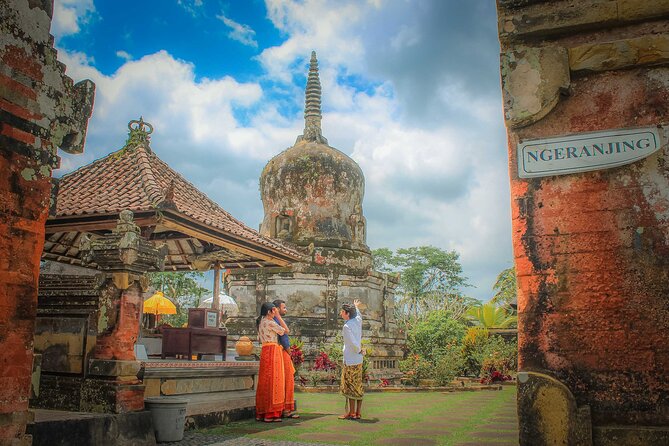
The final temple stop is the largest Buddhist stupa on Bali. Here, Hindu and Buddhist iconography are combined in a setting dedicated to Hindu and Buddhist cosmology.
This site completes the morning’s progression. You start with older ancestral beliefs, continue to a Hindu water temple, and end with a place where Hindu and Buddhist ideas meet. The sequence helps you see Balinese religion as layered and connected rather than divided into separate boxes.
The stupa is especially useful for visitors who assume Bali is exclusively Hindu. Hinduism is central to the island’s religious identity, but the tour shows how Buddhism also appears in its sacred art and architecture. Your guide can help you notice the shared symbols and explain why they belong together in this setting.
Do not expect the entire experience to feel like a grand monument tour. The appeal is the relationship between the sites. Each stop makes the next one easier to understand.
Lunch with the hosts
After the temple visits, you enjoy lunch with your hosts. Coffee and tea are included, as is the meal. Alcoholic drinks and snacks are not included, though they are available for purchase.
Lunch is more than a practical break. It gives you time to talk with the people who have welcomed you and to ask questions that may not occur while standing in a temple courtyard. The meal also keeps the tour connected to community life instead of ending as soon as the sightseeing is finished.
The published details do not give a menu or identify dietary options. If you have food restrictions, raise them when booking. Do not assume that snacks or alcoholic drinks will be part of the meal.
What the five-hour schedule feels like
The experience lasts about five hours and ends back at the meeting point. Private transportation is included, and only your own group takes part. That private setup matters because cultural questions often need more time than a standard group schedule allows.
You can ask why a temple uses a certain symbol, how subak works, or what a mask means without worrying about holding up a busload of people. The private vehicle also makes the route from Ubud and around Tampaksiring more straightforward.
At the same time, five hours passes quickly. The tour covers a family compound, three sacred sites, historical background, religious ideas, and lunch. You will receive a focused introduction, not an exhaustive study of Balinese architecture or religion.
The 9:00 am start is sensible for a half-day plan. It leaves the rest of your day open, though the tour’s end time may vary with driving and the pace of your group. Since the meeting point and return point are both listed at Bali Pure Tour, confirm exactly where hotel pickup will occur if you are not staying nearby.
Is the $98 price good value?
At $98 per person, this is not the cheapest way to see temples around Ubud. The price needs to be judged against what is included: private transportation, a private guide-led experience, lunch, coffee or tea, and entry to the scheduled temple sites.
The strongest value is the access to interpretation and local contact. You are not paying only for a vehicle and entrance tickets. You are paying for a guided connection between the valley’s ancient sites, a family compound, Balinese philosophy, and the religious practices you see.
The value is better for a small group because the private format gives you control over questions and attention. For a solo visitor or couple, the per-person price may feel high compared with a larger shared excursion. For a family or group dividing the private experience among several people, it can make more sense.
The optional holy spring ritual also adds value if you want an active cultural experience, while the choice to observe keeps the tour suitable for people who prefer not to take part.
Who will enjoy this experience most?
I would choose this tour if you want to understand Bali rather than simply collect temple photographs. It suits you especially well if you enjoy religious history, village life, architecture, local customs, and small-group conversation.
It is also a good fit for first-time visitors who want a clear explanation of how different traditions relate to one another. The three-site structure gives you an easy framework to remember after the trip.
Families and older visitors may appreciate the private vehicle and half-day length. The tour states that most people can participate, but it does not provide detailed accessibility information. Ask about walking surfaces, steps, and the practical conditions at the water temple if mobility is a concern.
You may want another type of excursion if you prefer markets, cooking, long walks, or outdoor scenery. This is a culture-focused morning with temple visits at its center.
Small details that can improve the morning
Wear clothing suitable for religious sites and bring a respectful attitude. Even if you do not take part in the holy spring bathing, you are entering active sacred places.
Bring questions. Ask about lontar script, the masks, subak, the compound layout, and the differences between the three religious settings. The tour’s value grows when you treat the guide as a cultural interpreter rather than a person who simply leads you from gate to gate.
If you hope to bathe at the springs, confirm the arrangements in advance and bring any personal items you may need. A sarong and towel are supplied, but the details of changing facilities are not provided.
The experience has free cancellation up to 24 hours before its local start time. Changes or cancellations made less than 24 hours before departure are not refunded, so keep that cutoff in mind when planning your Ubud schedule.
Should you book The Essence of Bali?
Book it if you want a private, thoughtful introduction to Balinese spiritual life, especially if the mix of ancient ancestral beliefs, Hindu practice, Buddhism, and village culture interests you. The family welcome, three temples, optional purification bath, and included lunch give the five-hour format real substance.
I would skip it if you want a relaxed scenic drive with minimal explanation or a long list of major attractions. This tour asks you to listen, observe, and show respect at sacred places.
For most culturally curious visitors, $98 is reasonable when shared with a group and worthwhile for the private guide, transport, meal, and local connection. Confirm pickup details, ask about food needs or mobility concerns, and arrive ready to learn. That is when this half-day trip gives you more than a series of temple stops.
FAQ
Where does The Essence of Bali start?
The stated meeting point is Bali Pure Tour, Banjar Penempahan, Jalan Melati, Desa Manukaya, Tampaksiring, Manukaya, Gianyar, Bali 80552. Pickup is offered, so confirm the exact arrangement when booking.
What time does the tour begin?
The start time is 9:00 am.
How long does the experience last?
The tour lasts about five hours and ends back at the meeting point.
Is this a private tour?
Yes. Only your group participates, and private transportation is included.
Can I take part in the holy spring bathing?
Yes, participation at the sacred water temple is optional. A sarong and towel are provided if you choose to take part.
What is included in the price?
The price includes coffee or tea, lunch, private transportation, and admission to the included temple visits. Alcoholic drinks and snacks are available to purchase but are not included.
Just added around Ubud
- Authentic hike in the forest with lunch at the inhabitant★ 5.0 · 3 reviews
- Heaven Gate, Tirtagangga and Tukad Cepung Waterfall – All Inclusive★ 5.0 · 3 reviews
- Half Day Uluwatu Temple Sunset, Kecak Dance and Seafood Dinner★ 3.5 · 3 reviews
- Ubud: White Water Rafting with visit Ubud Monkey Forest★ 5.0 · 3 reviews
- ️Bali All Inclusive Tour: Ubud – Tegalalang – Kintamani★ 5.0 · 3 reviews
- East Bali and Lempuyang Temple Tour★ 5.0 · 3 reviews
- Ubud: Temple, Swing, Waterfall, Rice Terrace & Monkey Forest★ 5.0 · 3 reviews
- Blue Lagoon Snorkeling and Lunch with Tukad Cepung Waterfall★ 5.0 · 3 reviews